

What Are You Retiring To?
This quarter, rather than providing a traditional market or legislative update, we wanted to share a reflection on one of the most important questions in retirement planning. Much of the focus in our industry centres on numbers, balances and investment returns. Yet retirement itself is often about something much deeper. We hope this article encourages you to pause, reflect and consider what retirement means for you.
Retirement: More Than Just a Number
Much of the public discussion around retirement focuses on access to advice, adviser numbers and the cost of receiving professional guidance. While these are important issues, retirement itself is a much broader concept than financial advice alone.
Perhaps retirement is best viewed not as a financial milestone, but as a holistic life project. Building a successful retirement project will require Resources, Clarity and Purpose.
Resources (money) funds retirement. Clarity makes reaching retirement achievable. Purpose makes retirement worthwhile.
We build resources over many years. Strong careers, disciplined savings, smart investing or simple family wealth will accumulate resources. However, the happiest retirees have also developed clarity of their path to retirement and an understanding of their purpose when they arrive.
Beyond the Numbers
Understanding the resources we will need to support our future is a challenge, if only because we compare our future needs with the current demands on finances. Mortgages, living costs, raising families, supporting ageing parents can drain our current resources.
There will eventually be a point where additional wealth makes little difference to our lifestyle. The challenge is that while we are accumulating wealth, it's almost impossible to know where that point lies.
The undeniable fact remains: financial security matters. Without sufficient resources, retirement choices can become limited, increasing uncertainty.
Yet research published by Vanguard and Russell Investments suggests a successful retirement is more nuanced than simply the accumulation of resources.
Nearly 3 in 5 retirees were more likely to report positive retirement sentiment compared with around 2 in 5 working-age Australians.1
Why are retirees reporting a better experience? What changes? The research strongly suggests confidence is the key difference.
People who had a clear retirement plan were significantly more likely to feel positive about retirement. Understanding what actions are needed and how available resources will support their lifestyle will increase confidence and reduce anxiety about the future.
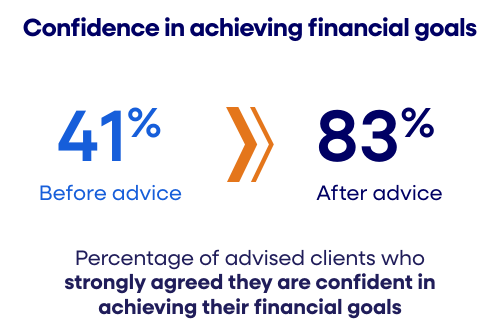
The Russell research shows a similar outcome when exploring the concept of the value of advice. The greatest benefit identified wasn't investment performance, it was confidence. Advice is important.
Source: Russell Investments: Value of An Adviser - 2026
Taken together, these findings point toward something deeper. A successful retirement will rest on three foundations: Financial Resources • Clarity • Purpose
1. Financial Resources
This is often where retirement conversations begin.
Do you have sufficient resources to support the lifestyle you want? Do you feel confident that the resources you have accumulated will support the lifestyle you want in the future?
For some people those resources may sit primarily in superannuation. For others they may be spread across investment portfolios, family trusts, companies, property holdings or personal savings.
The structure itself is often less important than the overall picture.
Retirement confidence tends to increase when people understand what they own, how those resources work together and whether they are likely to support their desired lifestyle.
Money cannot create happiness on its own, but financial security can provide freedom, flexibility and choice.
2. Clarity
Planning for retirement is a journey that spans decades. Time continues to move whether we have a plan or not. Knowledge helps guide our actions, but knowledge combined with wisdom is far more powerful. Together they provide clarity and reduce uncertainty.
Many Australians spend years worrying about retirement without ever answering some of the key questions:
- What lifestyle do I want?
- What will it cost?
- How long should my resources last?
- What decisions should I be making today?
The research consistently found that people who planned for retirement felt more confident and more positive about it.
Confidence is often not the result of having perfect information. It comes from understanding enough to make informed decisions and having a clear direction of travel.
3. Purpose
This may be the most overlooked part of retirement planning.
For decades, work provides structure, routine, challenge and social connection. Much of our identity becomes intertwined with what we do each day.
When work finishes, a new question emerges:
“What am I retiring to?”
Interestingly, retirees in the Vanguard research were more likely to focus on how they would spend their time, maintain their health and stay active than on purely financial considerations.
For some people, purpose comes through family and grandchildren. For others it comes through travel, volunteering, community involvement, hobbies, mentoring or learning new skills.
The common theme that threaded through the two research pieces is meaning – maintaining the sense of purpose that gives your life meaning.
Time is the true equaliser of all of us. Time does not defer to status or wealth; time is given to each of us equally and we each have a choice as to how we use it. Financial independence creates the opportunity to choose how we spend our time. Purpose gives that time value.
Retirement should be considered a holistic project not a simple financial goal.
Many analysts and their articles that try to help the retirement discussion end up reducing the conversation to a number.
But the research suggests the happiest retirees may not necessarily be those with the largest balances. More often, they are the people who have developed all three foundations:
- sufficient financial resources,
- clarity around their future, and
- a clear sense of purpose.
In other words, retirement is not simply about stopping work.
It is about having the resources to support your lifestyle, the confidence to enjoy it and something meaningful that makes you want to get out of bed each morning.
Perhaps the most important retirement question is not: “When can I afford to retire?” but rather,
“What am I retiring to?”
Because while financial resources may fund retirement, purpose is often what makes it rewarding.
1 Vanguard: How Australia Retires - September 2026